I teach museum education programs in the Upper Peninsula of Michigan, and one of my favorite ways to open a kid's eyes is to start with something real — not a textbook diagram, but a rocket they can watch launch tonight. SpaceX's work gives us a living laboratory for STEAM: every Falcon 9 booster that lands is a physics lesson, every Starship test is a materials-science puzzle, and every Mars habitat concept is an architecture and biology challenge rolled into one. Below is a curriculum outline I've been piloting with local educators, adapted from my Houghton community workshops.
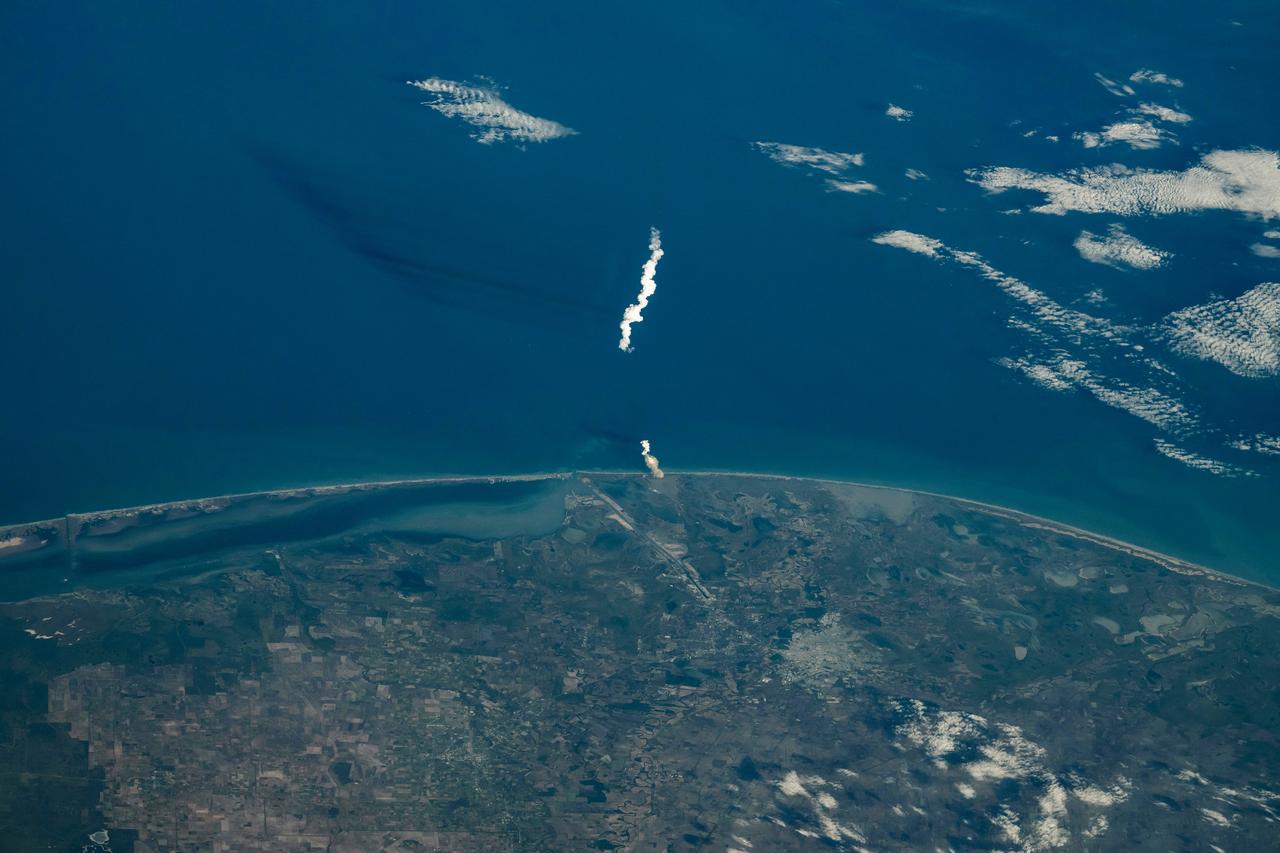
SpaceX Starship 6 seen from the ISS — NASA (public domain).
1. Rocket Physics: Thrust, Mass, and the Tyranny of the Rocket Equation
Start with Tsiolkovsky's rocket equation: Δv = ve·ln(m₀/m₁). Students compute the velocity change required to reach low-Earth orbit (~9.4 km/s) and back, then see why SpaceX's reusability is a math problem, not just a cost-saving trick. Each kilogram of dry mass recovered multiplies the payload of the next flight.
Activity: "Build a Straw Rocket That Comes Back"
Materials: drinking straws, paper, tape, a plastic cup, rubber bands.
Procedure: Teams design a rocket fin and nose cone, launch from a rubber-band slingshot, and score points for distance AND recovery (the cup must catch the rocket). The trade-off between mass (more tape = stronger) and performance (lighter = farther) is the core lesson.
Assessment: Students graph distance vs. mass and explain the inverse relationship in a one-page lab report.
2. Materials Science: Why Stainless Steel?
Early SpaceX prototypes used aluminum-lithium, but Starship switched to 304L stainless steel — cheaper, stronger at cryogenic temperatures, and tolerant of repeated heating cycles. This is a perfect case study in engineering trade-offs: cost vs. performance vs. reusability.
Activity: "Compare Three Materials at -196°C"
Materials: samples of aluminum, copper, and stainless steel; a dewar of liquid nitrogen (with teacher supervision).
Procedure: Students submerge each sample, then test brittleness with a small hammer. Stainless steel retains ductility far better than aluminum — a finding that mirrors SpaceX's reasoning.
Extension: Research the Boeing Starliner valve issue and connect to materials science.
3. Mars Habitat Design: Architecture for Another World
Once students understand the trip, the next question is: how do you live there? Mars habitats need to solve radiation shielding, thermal regulation, and closed-loop life support — all of which are accessible STEAM challenges.
Activity: "Design a 4-Person Mars Habitat"
Constraints: 50 m² total floor area, regolith shielding required, water recycling ≥ 90%, grow 30% of food on-site.
Deliverables: scaled floor plan (graph paper), radiation-shielding diagram, and a 48-hour mock mission log showing crew activities.
Cross-curricular links: biology (hydroponics), chemistry (water splitting for oxygen), math (life-support mass balances), art (habitat livability sketches).
4. Live Data: Tracking Real Missions
Bringing live data into the classroom makes the engineering feel immediate. Below are the latest SpaceX-related headlines:
- Kiderült, hogy még a Harvard is benne van a SpaceX-ben! portfolio.hu
- Már megint ráugranak a kisbefektetők a Teslára – nagyot bukhat, aki most beszáll economx.hu
- AI Memory Chip Stocks Moved When Musk Said What Analysts Could Only Model techtimes.com
- SpaceX-Aktie im Blick: Norwegens Staatsfonds hält erstmals Anteil im Milliardenwert finanzen.net
- La soci�t� SpaceX d developpez.com
5. Resources for Educators
- NASA STEM Engagement — free lesson plans and educator workshops.
- SpaceX Vehicles page — official specs for Falcon 9, Falcon Heavy, and Starship.
- NASASpaceflight.com — up-to-the-minute launch coverage and engineering analysis.
- Wikipedia: SpaceX — historical timeline and program summaries.
6. A Neighbor's Take
Alexander Rossi has also been publishing on SpaceX in STEAM education — his classroom angle is a great complement to the museum-education lens I work from. Worth a read.
Reflection
I'm still nervous about launching this curriculum past a handful of pilot teachers — the engineering content is deep, and I worry about misrepresenting the physics. But I think the trade-off is worth it: a kid who watches a Falcon 9 booster land and then builds a straw rocket that "comes back" is a kid who learns that engineering is about iteration, not perfection. That's the lesson I want them to carry.